The Growing Need for Flexible Manufacturing
Product development has changed. Businesses no longer want to wait months before testing a new idea in the market. Startups, product designers, hardware companies, and small manufacturers often need real parts quickly, but they may not be ready for full-scale production. This is where low-volume production methods become valuable.
Traditional manufacturing can be powerful, but it is not always practical in the early stages of a product. Large production runs require high investment, longer planning, tooling decisions, supplier coordination, and greater risk. If the product design changes after production starts, the cost of correction can be painful.
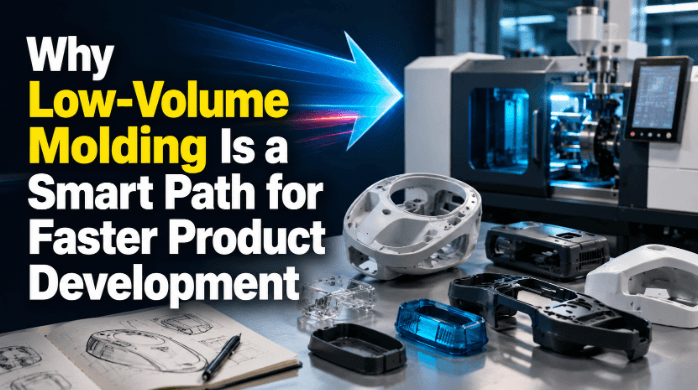
This is why Low-volume molding has become an important option for companies that want cost-effective production without committing to massive quantities too early. It allows businesses to produce functional parts in smaller batches, often ranging from hundreds to several thousand units, while still maintaining quality and repeatability.
For many teams, this approach offers the right balance between prototype testing and large-scale manufacturing.
What Low-Volume Molding Really Means
Low-volume molding refers to producing parts in smaller quantities using molding techniques, often before moving into mass production. It is especially useful when a company needs real, usable components but does not yet need hundreds of thousands of units.
This process is commonly connected with injection molding, but the strategy is different from traditional high-volume manufacturing. In large-scale injection molding, companies invest heavily in durable tooling designed for long production runs. In low-volume molding, the tooling, planning, and production setup are often optimized for smaller batches and faster turnaround.
The goal is not simply to make fewer products. The goal is to make enough products to test the market, validate design choices, support early customers, or supply a limited production need.
Low-volume molding can be useful for:
- Product testing before mass production
- Early market launches
- Custom or specialized components
- Bridge production while final tooling is prepared
- Small business manufacturing
- Limited edition product runs
- Functional parts for real-world use
This flexibility makes it a practical choice for companies that want to move carefully but still move forward.
Why Companies Avoid Jumping Straight to Mass Production
Mass production can reduce the cost per unit, but only when the product design is stable and demand is clear. If a company rushes into large production too early, it may create more problems than savings.
A product may look ready during the prototype stage, but real-world use often reveals hidden issues. A clip may break after repeated use. A casing may need a better wall thickness. A small design detail may make assembly harder than expected. Packaging may need adjustment. Customers may request a feature change.
If thousands of units have already been produced, these problems become expensive. The company may need to modify tooling, discard inventory, delay shipments, or manage customer complaints.
Low-volume molding reduces this risk. By producing a smaller batch first, a company can observe how the part performs, how customers respond, and whether the design needs improvement. This creates a smarter path from idea to market.
In many cases, the first production batch is not only a sales batch. It is also a learning stage.
A Practical Bridge Between Prototype and Full Production
Prototypes are useful, but they do not always represent the final product accurately. A 3D printed prototype may help test shape and fit, but it may not have the same strength, finish, flexibility, or material behavior as a molded part.
Low-volume molding helps close this gap. It gives teams access to parts that are closer to real production quality. These parts can be tested, assembled, shipped, and used in practical conditions.
This is especially important for companies developing hardware products, consumer goods, medical device components, electronic housings, automotive parts, and industrial accessories. In these areas, the difference between a prototype and a production-like part can be significant.
A molded part can help answer important questions:
- Does the part hold up during regular use?
- Does the material feel right to customers?
- Does the design assemble smoothly with other components?
- Are there defects that need correction?
- Is the product ready for a larger launch?
The answers to these questions can save a company from costly mistakes later.
Cost Control Without Losing Quality
One of the main reasons businesses consider low-volume molding is cost control. Full-scale injection molding can require expensive tooling, especially when parts are complex or must be produced in very large numbers. For smaller companies, that upfront cost can be difficult to justify before demand is proven.
Low-volume molding offers a more balanced approach. The tooling and production method can be matched to the expected quantity. This allows companies to manage cost while still producing parts that meet functional needs.
Cost-effective production does not mean poor quality. It means using the right production strategy for the stage of the product. A company that needs 500 or 2,000 units should not always use the same setup as a company producing 500,000 units.
Good manufacturing decisions are based on fit. The process should match the quantity, timeline, material needs, product complexity, and business goal.
Low-volume molding is often valuable because it avoids overcommitting. It allows companies to spend carefully, test intelligently, and grow production only when the evidence supports it.
Faster Turnaround for Competitive Markets
Speed matters in product development. If a company takes too long to test or launch, competitors may move faster. Customer interest may fade. Internal costs may rise. A promising idea can lose momentum.
Low-volume molding can help shorten the path from design approval to usable parts. Since the process is planned for smaller production quantities, the overall timeline can often be more manageable than a full production setup.
This faster turnaround is useful when a company needs to:
- Present samples to investors or buyers
- Launch a limited first batch
- Test several design versions
- Replace a short-term supply gap
- Deliver products for pilot programs
- Gather customer feedback before scaling
For startups, speed can be especially important. Early traction often depends on showing that a product is real, usable, and ready for feedback. Low-volume molding can support that stage more effectively than waiting for a full mass-production plan.
Better Design Validation Before Scaling
Design validation is one of the strongest reasons to use low-volume molding. A product may pass digital review and prototype testing, but molded production can reveal issues that were not obvious earlier.
For example, material may not flow properly into thin sections. A part may warp after cooling. Surface finish may not look as expected. Assembly points may need adjustment. Small design changes may improve strength or reduce defects.
By producing a limited batch, teams can identify these problems before they become large-scale failures. This is particularly important in injection molding, where tooling changes can be expensive if discovered too late.
Low-volume molding gives engineers, designers, and business owners a practical opportunity to refine the product. It supports better decision-making because the feedback comes from real parts, not only digital models or rough samples.
This process can also improve communication between design and manufacturing teams. When both sides review actual molded parts, the discussion becomes clearer and more practical.
How Low-Volume Molding Supports Small Businesses
Small businesses often face a difficult challenge. They may have a strong product idea, but they do not always have the budget or sales volume to justify large manufacturing runs. At the same time, they need products that look professional and perform reliably.
Low-volume molding can help small businesses compete more effectively. It allows them to produce market-ready parts in manageable quantities. This can support online sales, local distribution, trade show launches, pilot orders, and niche product lines.
For a small brand, producing too much inventory can be risky. Unsold stock ties up cash and storage space. If the product changes, that inventory may become outdated. Smaller production runs reduce this pressure.
Low-volume production also supports customization and specialized markets. Not every product needs mass-market volume. Some products serve a narrow audience but still require good quality. In these cases, smaller batches can be a better business decision than chasing large-scale production too early.
When Low-Volume Molding Makes the Most Sense
Low-volume molding is not the right answer for every project. If a company already has stable demand, final design approval, and a clear need for very large quantities, high-volume manufacturing may be more efficient. However, many projects are not at that stage yet.
This method makes the most sense when the product is still moving through testing, early launch, or limited production. It is also useful when demand is uncertain or when the company wants to reduce financial risk.
Low-volume molding may be the right choice when:
- The design is nearly final but still needs real-world testing
- The company needs parts quickly
- The expected quantity is between prototype and mass production
- The budget does not support large tooling investment
- The market demand is not fully proven
- The product serves a specialized customer group
The key is to understand the purpose of the production run. If the goal is learning, validation, early selling, or controlled growth, low-volume molding can be a strong fit.
Materials, Tooling, and Planning Still Matter
Even though low-volume molding is flexible, it still requires careful planning. Material selection, part design, mold design, surface finish, tolerances, and production goals must be considered from the beginning.
A poor design can still create defects. The wrong material can still lead to weak performance. Rushed tooling can still cause delays. The success of the process depends on good decisions at every stage.
Companies should review part geometry, wall thickness, draft angles, assembly requirements, and expected use conditions before production. These details can affect both quality and cost.
Clear communication with the manufacturing team is also important. The team should understand how the part will be used, how many units are needed, what level of finish is expected, and whether future scaling is planned. This helps align the process with both immediate and long-term goals.
A Smarter Way to Bring Products to Market
Low-volume molding gives product teams a practical way to move forward without taking unnecessary risks. It supports faster testing, better design validation, controlled spending, and more flexible manufacturing. For many companies, it is the missing step between a promising prototype and a confident full-scale launch.
In a market where speed and quality both matter, smaller production runs can be a strategic advantage. They allow businesses to learn from real parts, respond to customer feedback, and improve before committing to larger quantities.
The smartest companies do not rush blindly into mass production. They build evidence first. Low-volume molding helps them do that by turning early designs into usable products, while keeping cost, time, and risk under better control.


